
Zhoufan Chen, AIA, Yuhua Zha
ArchiDogs
(Sherry Xi Li, Lu-Ming Chen, Yanhong Chu)
Contractorr:
somo Space Design Co., Ltd.
Kejia Mei
Lu-Ming Chen
%20View%20from%20the%20main%20entrance%20into%20the%20interior%20space_ADJ.jpg)


.jpg)
.jpg)
.jpg)
.jpg)
.png)
.jpg)
/When Brand Display Becomes a Multiplier of Resource Consumption
In contemporary brand context, exhibitions remain one of the most direct and powerful platforms. Large-scale spaces, immersive experiences, and strong visual narratives can rapidly amplify brand influence. Yet behind the spotlight of exhibition periods, massive amounts of temporary construction materials are dismantled and discarded, resulting in serious resource waste and environmental burden.
More critically, under tight construction schedules and intensive on-site work, exhibition halls are often filled with dust, noise, and strong adhesive odors before opening. Even days after launch, these pollutants may persist, posing hidden health risks to both visitors and staff. As “effective exposure” continues to coexist with “unsustainability,” how exhibition spaces can fulfill branding goals while assuming greater social responsibility has become an unavoidable question.
/From Curatorial Vision to a Sustainable Spatial System
As a key stage in O-Wood’s brand upgrade, the pavilion was conceived not merely as a material display, but as a physical manifestation of brand values. The curation team combined global environmental concerns with in-depth research on SPC (Stone Plastic Composite) material forming, shaping, and rapid assembly, proposing two core curatorial principles: “Material Honesty” and “Environmental Sustainability.” The intention was to allow material performance, construction logic, and spatial outcome to communicate directly, rather than relying on excessive visual packaging.
The spatial design team translated O-Wood’s core values—zero formaldehyde, recyclability, full prefabrication, customization, and sustainability—into a perceivable spatial language through a modular construction system.
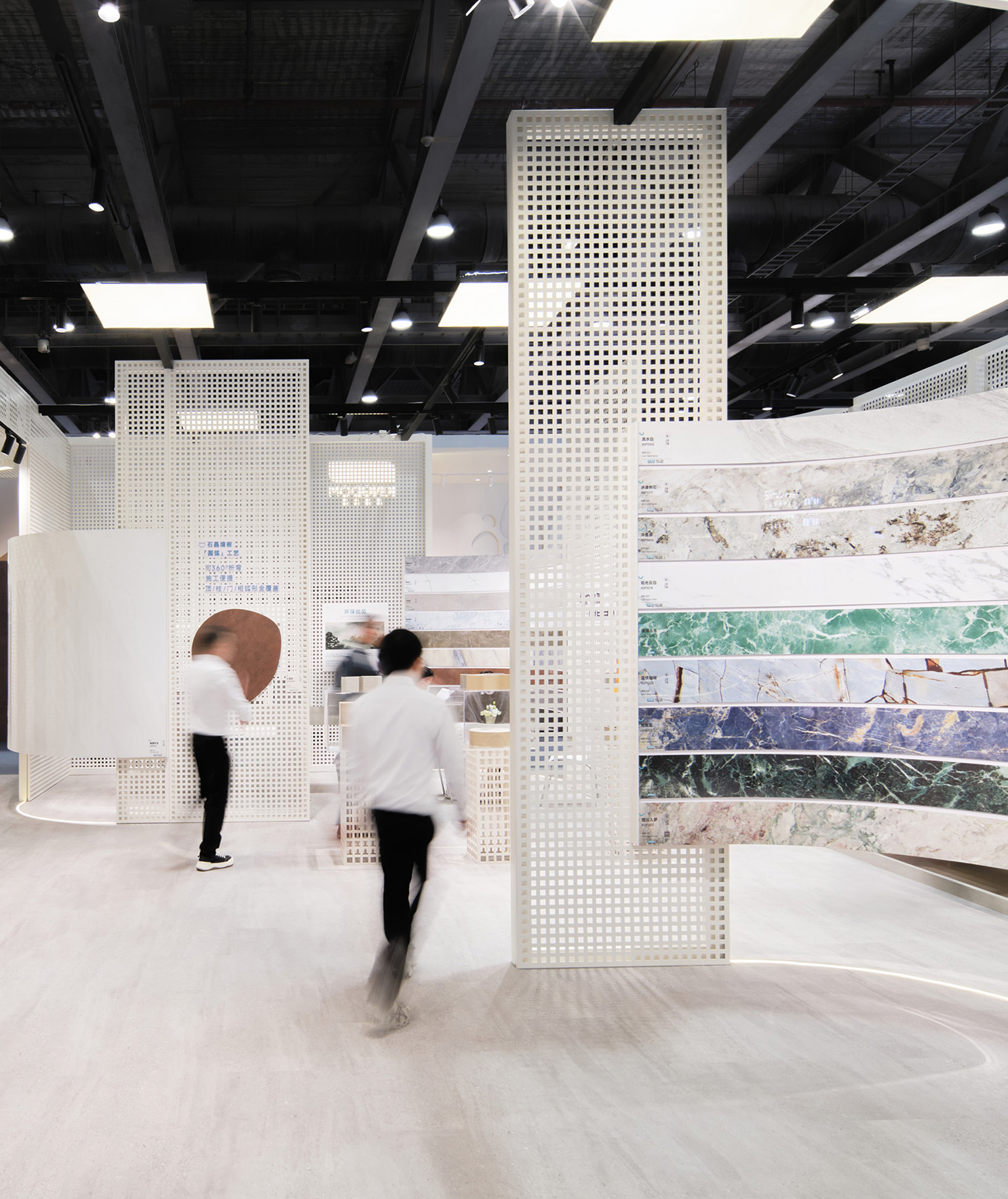
The pavilion concept, “Wandering Matrix,” juxtaposes rational, precise modular grids with free and exploratory movement. Visitors wander within an ordered system, experiencing variation within standardization. This concept also responds to the brand’s global exhibition needs. A 3×3-meter module (approximately 10×10-feet) serves as the basic unit, forming a universally adaptable system that maintains strong structural identity while allowing diverse spatial configurations. Structurally, perforated aluminum panels provide visual transparency and flexible hanging conditions, with the FRP (Fiber Reinforced Plastic) furniture supports rapid assembly and disassembly. Experimental models, technical samples, material specimens, and full-scale assemblies are combined to present the strength, plasticity, and customization potential of SPC materials.
At key visual nodes, curved walls formed by bent SPC panels create expressive surfaces while guiding circulation and organizing exhibition, meeting, resting, and storage functions. After the exhibition, all structural frames, furniture, and samples are fully recoverable for future reuse, extending the life cycle of the pavilion system.
/Toward a Replicable Model of Responsible Exhibition Design
Despite social advances, physical exhibition spaces remain the most direct interface between brands and the public. Compared with digital media, they offer direct sensory engagement and spatial experience, helping audiences better understand new materials, technologies, and construction methods. The O-Wood Pavilion does not represent a singular “green display,” but rather an integrated response spanning curatorial thinking, design methodology, and construction systems. While maintaining branding efficiency, it actively reduces resource consumption and environmental impact. The project proposes a replicable and scalable model for future exhibitions—transforming temporary pavilions from short-lived stages into lasting platforms where brand value and social responsibility converge.
